
Ma Jiancong, Deputy General Manager of Sinopharm Group Guangzhou Co., Ltd., said: "This automated logistics center, which has now been in operation for more than 10 years, has achieved an intelligent upgrade without delaying normal business operations for a single day, raising overall warehouse efficiency by 25%. Thanks to the ingenious design that connects the two warehouses and ATOMIX's leading smart logistics solution, the logistics center has increased storage density by 15% and finishes operations 2 hours earlier, which has a demonstration effect for digital-intelligent upgrades in the pharmaceutical distribution field."
Technology empowerment: exploring a new direction for digital-intelligent upgrades
As policies such as the two-invoice system and volume-based procurement are implemented in greater depth, cost pressure on pharmaceutical distribution companies keeps rising. At the same time, new pharmaceutical retail is gradually gaining momentum, and the previous supply chain operating model can hardly adapt to a dramatically changing market environment. Compared with ordinary goods, pharmaceuticals carry higher and more difficult quality management requirements, and the traditional approach to increasing the pace of inbound and outbound operations has clearly slowed.
In 2020, the General Secretary and 13 departments including the NDRC called for efforts to "encourage enterprises to carry out intelligent logistics transformation and to promote the application of new types of technical equipment such as logistics robots, smart warehousing and automated sorting; and to coordinate the hardware and software development of the modern distribution system." Smart logistics has been named by the state as a lever for boosting domestic circulation. Sinopharm Guangzhou sensed keenly that digital-intelligent transformation had become the only way for the industry to create incremental growth.
Sinopharm Guangzhou's automated logistics center has been in operation for more than 12 years, its business volume has long since grown several times over, and its capacity has already hit a ceiling. After evaluations from multiple sides, the optimal solution was to build on the existing AS/RS automated system and introduce autonomous mobile robots (AMRs) and AI technology to achieve the digital-intelligent transformation.
As a leading pharmaceutical distribution and supply chain service provider in southern China, Sinopharm Guangzhou has always centered on Sinopharm Yizhi's core initiative of "technology empowering service upgrades." Targeting the difficulties and pain points common in the pharmaceutical distribution industry, it was among the first to lay out digital-intelligent operations and has explored an upgrade path that requires neither stopping operations nor rebuilding. It is understood that Sinopharm Guangzhou's logistics center has 200 million yuan of pharmaceutical sales to ship every working day, and one day of shutdown would mean huge economic losses and would seriously affect drug supply in Guangdong and Guangxi.
For this reason, in 2020, after half a year of calculation and discussion, Sinopharm Guangzhou introduced autonomous mobile robots (AMRs) and AI technology developed by ATOMIX, and ultimately achieved a seamless upgrade without delaying business operations for even a single day, charting a feasible path for companies across the pharmaceutical distribution system that urgently need intelligent upgrades to move a pharmaceutical logistics center from automation to intelligence through digital-intelligent transformation.
The smart logistics solution
In response to Sinopharm Guangzhou's need to expand capacity and to guarantee customer order lead times and service levels, Sinopharm Guangzhou transformed its original single warehouse — a conventional automated high-bay warehouse (AS/RS) plus manual picking — into two connected warehouses where AS/RS, AMRs and AI work together; with ATOMIX's smart logistics solution, which offers high return on investment (ROI), high flexibility, high utilization, fast deployment and easy maintenance, overall warehouse efficiency rose by 25% and operations finish 2 hours earlier.
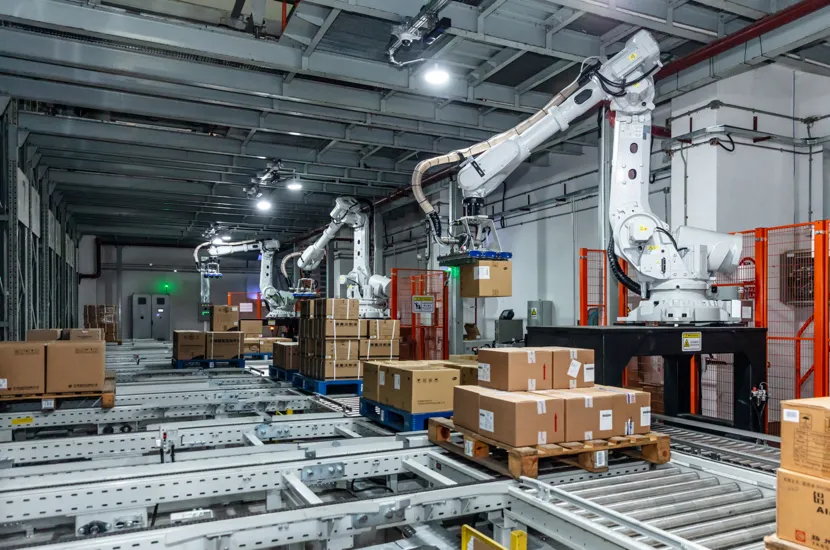
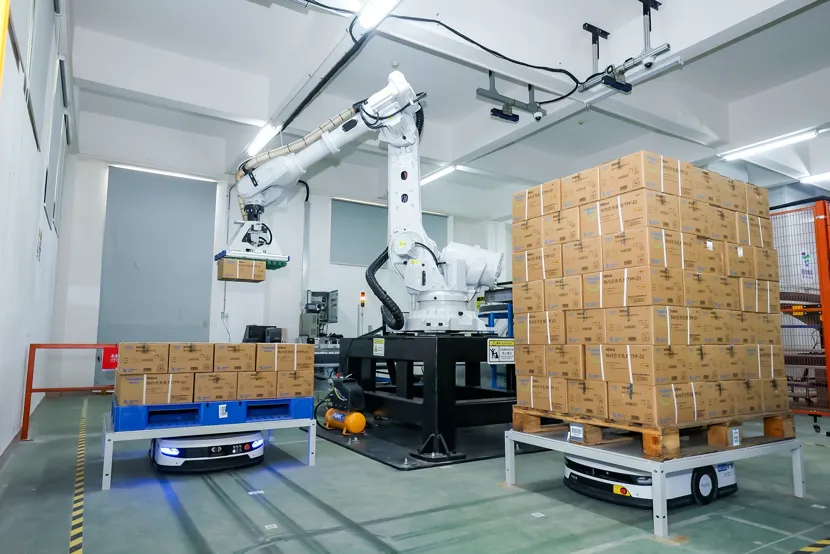
In the AS/RS automated storage and case picking operations, AI robotic arms with machine vision and intelligent control were deployed to reduce manual workload and raise efficiency. The high-bay warehouse stores 2,000+ SKUs, and each SKU differs in cargo dimensions and stacking pattern, while the cartons vary widely in color, top sealing-tape style and strapping style. According to the company, case picking in this high-bay warehouse amounts to about 6,000 cases a day; under the previous manual model, workers carried an average of 15,000 kg a day, whereas with robotic arms equipped with AI machine vision, depalletizing and palletizing efficiency has improved by 106% overall, greatly reducing the physical strain on workers.
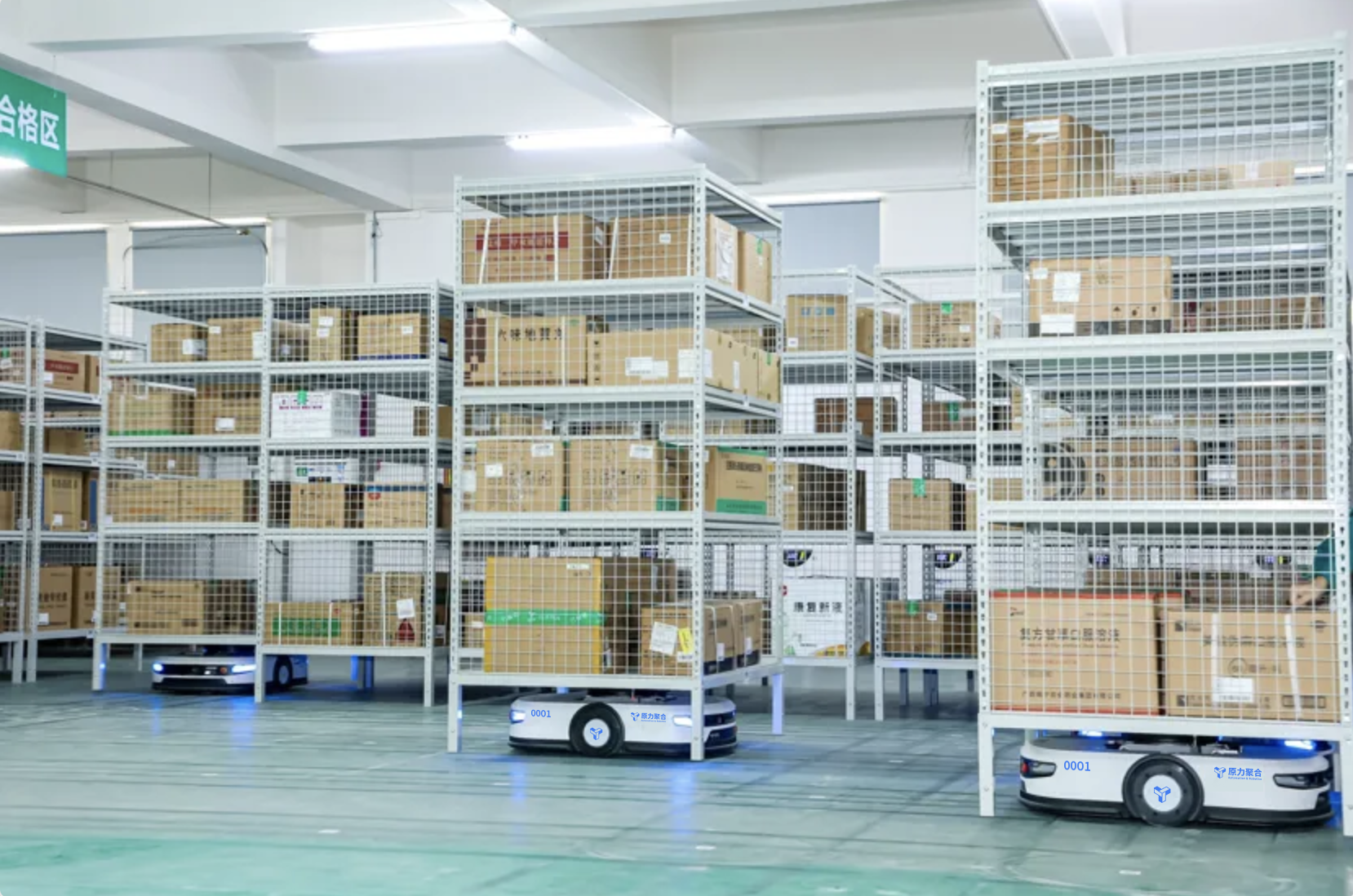
In the rack-based case picking operations, picking used to depend on people walking all over the floor, with each person taking 30,000 steps a day. Now autonomous mobile robots (AMRs) carry the racks, queuing up to shelve goods and to go outbound, realizing goods-to-person (GTP) automated and intelligent operations throughout the whole process from inbound to outbound; no matter how large the volume, there is no need to worry about travel distance. As a result, pickers not only run a "half marathon" less each day, but efficiency has also improved greatly.
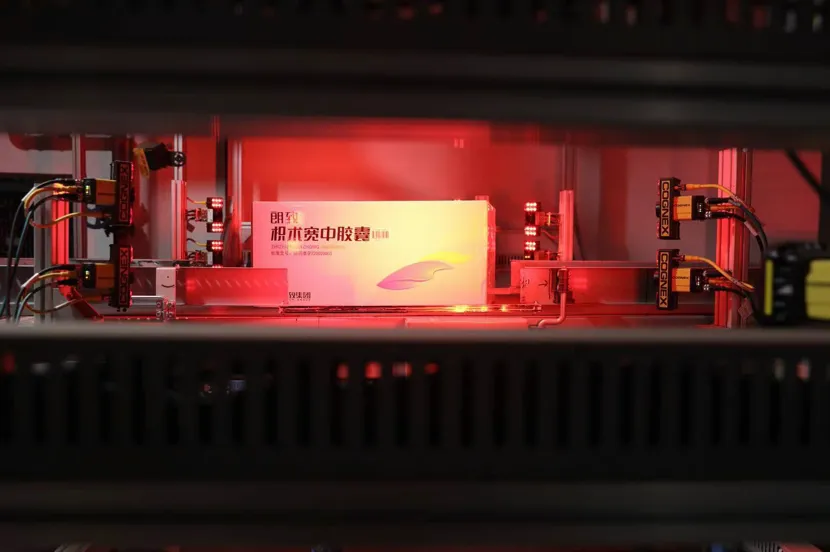
In addition, before the sorting stage, the Sinopharm Guangzhou warehouse adopted an AI five-sided vision scanning system. This system can automatically scan and identify original pharmaceutical cartons running at high speed, read all barcodes on the five sides — front, back, left, right and top — and, after effective filtering, bind the drug regulatory code with the logistics code and send them back to the WMS system, achieving fast sorting of cartons on the one hand and transparency and traceability on the other.
The diverse equipment in the warehouse — AMR robots, AI robotic arms, the AI five-sided vision scanning system, AS/RS stacker cranes and conveyor lines — is managed in a unified way through the smart logistics operating system, which also connects the multiple layers of equipment control systems in the warehouse, including WCS, WMS and RCS, achieving efficient scheduling and management of the entire warehouse.
Tens of millions in economic benefits, injecting support into the pharmaceutical distribution industry
The upgrade of the Sinopharm Group Guangzhou logistics center achieved capacity growth and fully automated operations. The capacity growth meets current business needs while requiring no additional warehouse operating area, saving on warehouse leasing costs; calculations show that after the upgrade, the project saves more than 1 million yuan a year in labor costs and will save Sinopharm Guangzhou more than 10 million yuan over the next five years. Alongside these cost savings, the successful launch and effective operation of the project will bring greater social benefits and an industry demonstration effect.
At a time when the pandemic has become a normal condition, Sinopharm Guangzhou, as a central pharmaceutical emergency reserve unit, will benefit from its intelligent upgrade in responding quickly to pharmaceutical material distribution needs and in helping to improve the service capacity of primary healthcare institutions. Sinopharm Guangzhou's exploration in the field of smart logistics has improved its pharmaceutical logistics service capability and will, to a certain extent, also drive the high-quality development of the health industry in Guangdong Province and across the country, providing the public with better and higher-level health services.
For the pharmaceutical logistics industry, Sinopharm Guangzhou's first intelligent upgrade project — upgrading while operating — has shown the industry the possibility of achieving intelligent upgrading along a different path: it does not necessarily take a new warehouse or logistics center to move into intelligence. This project has a strong demonstration effect for the pharmaceutical commercial field and will effectively drive deeper automation and intelligent transformation in pharmaceuticals and smart logistics, promoting high-quality development of the industry. In the future, Sinopharm Guangzhou will further explore innovative models of pharmaceutical logistics, tap the value of AI in the pharmaceutical field, and keep replicating its successful experience into more real-economy industries that need intelligent transformation.